
To the overview of the basics
→ To the home page
Ownership or access – the difference when it comes to money
In everyday life, it feels as though you simply own your money. You see your account balance, and you can transfer funds, make payments, or withdraw cash.
But technically, modern money often works differently. With a bank account, you generally don’t own the money itself; instead, you simply have a claim to it. Access is provided through a system that manages its use.
That is exactly the difference we will be looking at on this page.
Table of Contents
What ownership means in terms of money
Possession means direct control.
With cash, it’s easy to understand: You hold the money in your own hands and can use it at any time. No one has to approve a payment. No one decides whether you’re allowed to use it. As long as you own it, you can do whatever you want with it. You’re in complete control.
What access means
You don’t actually hold any physical cash there. Instead, you have the right to use money through an account. When you initiate a payment, a system processes the transaction. This means:
There is an infrastructure between you and the money that manages access to it. As long as these systems are working, you hardly notice this difference in everyday life.
Why modern systems organize access
Electronic payments only work if it is possible to clearly identify who the money is being credited to.
When you make a bank transfer, pay with a card, or use an app, no money is physically moved. Instead, a record is simply kept in the background of who is owed what.
For this to work, systems must
- Manage accounts
- Check payments
- Execute transactions
Digital payment systems primarily manage money through access rights. This infrastructure ensures that payments can be processed quickly, securely, and worldwide.
Your account balance shows how much money you have available—but whether you can use it depends on whether the system grants you access.
When the difference becomes visible
In everyday life, ownership and access appear to be the same: a payment works. The difference only becomes apparent when a decision has to be made about whether to use something.
For example, when
- a payment is being processed
- a system is temporarily paused
- several parties are involved in a transaction
In moments like these, you suddenly realize that there is always a structure underlying the relationship between money and how it is used. That is when the real difference becomes apparent:
Ownership means direct control.
Access means the right to use.
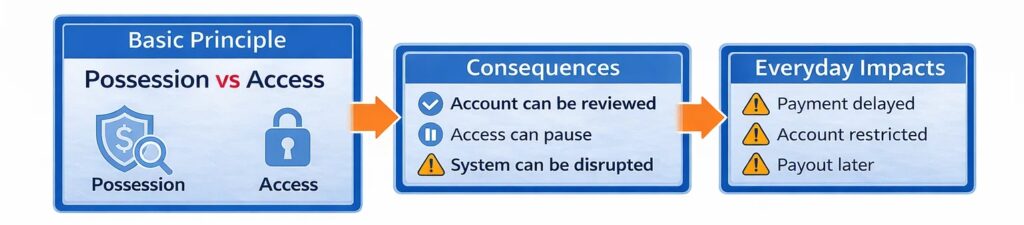
This automatically raises the fundamental question of which structure can actually be considered secure.
Conclusion
Modern money is often based not on direct ownership, but on organized access.
As long as systems function smoothly, this difference hardly matters in everyday life. It only becomes apparent when access is no longer automatic.
It then becomes clear that availability does not depend solely on the account balance, but on how access is organized. Therefore, it is not only the amount of money available that matters—but also the way in which it can be accessed.
In everyday life, ownership and access are usually treated as the same thing—but in practice, they are not.
FAQ – Ownership and access to money
What does ownership mean in relation to money?
Ownership means direct control, with no other entity involved.
What does access mean in relation to money?
Access means the ability to use money within a system, whereby execution is carried out by a structure.
Why is digital money based on access rather than ownership?
Because electronic payments only work if usage can be coordinated and assigned.
Is access the same as ownership?
No. Access describes usage, ownership describes legal entitlement.
Why does access feel like ownership in everyday life?
Because payments are usually executed automatically and no difference is visible.
When will the difference become noticeable?
It only appears when a decision must be made as to whether or not to execute a use.
Further reading
- Who owns the money in a bank account? Ownership or a claim
- Can the bank freeze my account? – Reasons and consequences
- Crypto or bank—which is safer?
Questions or personal classification
Many discussions about money revolve around ownership. In practice, however, it often turns out that access to money and its actual availability play just as important a role. This page explains the fundamental difference between ownership and access in the financial system and why the two terms are often treated as synonymous in everyday life.
The key question, then, is: What matters more to you—owning money or having access to it?
If you’d like, we can take a quick look together at how your finances are currently organized and which models allow for different forms of control.


This page describes how payment systems work and does not constitute legal advice.