
Go to the overview of the basics
→ Go to the home page
Can the government freeze my account?
Classification
Yes. Government agencies can restrict access to an account or have it frozen under certain conditions. The funds in the account do not automatically disappear—initially, it is access, availability, and practical use that are affected.
While banks may restrict accounts for internal reasons or due to legal audit requirements, this page addresses a different situation: measures ordered directly by government agencies or courts.
The real question, however, is the same: “Do I actually have access to my money right now?”
Table of Contents
What this means in practice
In everyday conversation, people often say in general terms that “the government freezes an account.” Technically speaking, this means that a government agency or a court orders a measure that is then carried out by the bank.
For example, the following could happen:
- The account will be garnished
- Transfers are blocked
- Withdrawals are only possible to a limited extent
- A portion of the credit balance is reserved
As a rule, the money doesn’t disappear; access to it is often restricted.
Who can initiate access
It is not “the government” as an abstract entity, but specific agencies that can initiate measures. These include, for example:
- Courts
- Tax offices
- Enforcement authorities
- Investigative authorities in the context of legal proceedings
In such cases, the bank generally does not act on its own initiative, but rather implements a legally mandated measure.
Why government regulations are having a greater impact on payment systems today
Access to financial data and payment systems is increasingly being coordinated not only at the national level but also at the European level.
AMLA
The new EU anti-money laundering authority is intended to standardize oversight and cooperation among financial institutions.
MiCA
MiCA establishes, for the first time, a Europe-wide legal framework for crypto-assets and related providers.
DAC8
DAC8 expands reporting requirements in the crypto sector and facilitates the exchange of information between tax authorities.
CARF
The OECD Crypto-Asset Reporting Framework serves as the basis for reporting standards for crypto transactions.
EU Anti-Money Laundering Act
Banks and financial service providers must implement suspicious activity reports more consistently and rigorously.
Overall transparency
Cash flows, wallet withdrawals, and financial activities will become more visible and verifiable.
In practice, this means that not every transaction results in a hold. However, as verification, reporting, and transparency requirements become more stringent, there is a greater likelihood that accounts, payments, or outgoing transactions will be temporarily suspended or subject to closer scrutiny.
Common reasons for account suspension
Tax or financial claims
- outstanding tax liabilities
- Enforcement proceedings
- judicially confirmed claims
Investigations or legal proceedings
- Suspected criminal activity
- unexplained cash flows
- legally mandated protective measures
Greater transparency in cryptocurrency and cross-border transactions
This area is becoming increasingly important, particularly in the European context. As more data on crypto transactions, e-money, and cross-border structures is automatically reported and analyzed, the likelihood that suspicious activities will be detected and investigated more quickly increases.
Garnishment instead of a complete freeze
The account is not “completely closed”; rather, access to it is partially blocked or garnished. That is why it is important to distinguish between the account balance, the right to the funds, and actual use. In many cases, the account technically remains open—only access to the funds is blocked.
How the process works
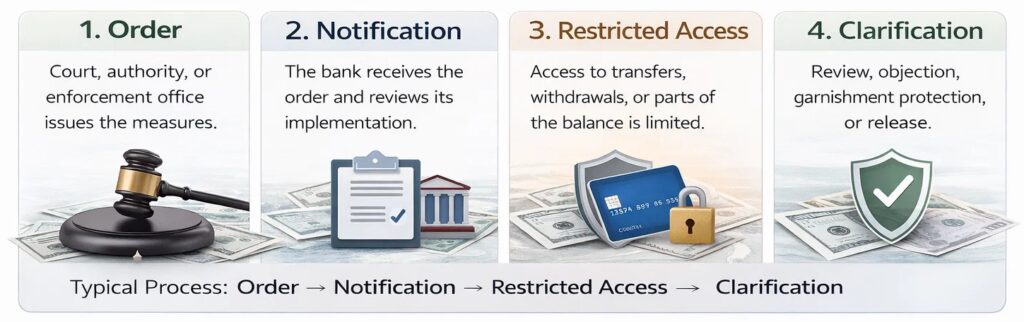
The key point is that the measure usually does not affect “the money itself,” but rather access to that money.
What you can do
If an account has been restricted or frozen, the first step is not to panic, but to stay calm. It’s usually a good idea to:
- Carefully review the message from the bank or government agency
- Determine the cause of the action
- Please observe the deadlines
- seek legal advice if necessary
- Check your options for protection in the event of garnishments
It is particularly important to determine whether the restriction is a complete freeze, a garnishment, or merely a limited restriction on access.
What are the limits?
Access by the government or public authorities is also subject to rules. Public authorities do not have complete and unrestricted access in every situation.
- Garnishment-protected accounts can shield certain exempt amounts
- Not every measure is unlimited
- Depending on the procedure, there are rights to file an objection and to request an examination
That is precisely why the real question is usually not just a legal one, but a practical one: How quickly and to what extent will funds remain available in an emergency?
In addition to government measures, another question arises:
What actually happens to your account balance if a bank runs into trouble or has to close?
Conclusion
Yes—under certain conditions, government agencies can restrict access to an account or have it frozen. In the European context, the regulatory framework governing this is becoming even more stringent due to stricter reporting, auditing, and transparency rules.
At its core, this is not just about ownership or account balances, but about availability. Anyone familiar with monetary systems will recognize the same principle here as in many other contexts: ownership, entitlement, and access are not automatically the same thing.
FAQ – Account Freeze by the Government
-
Can the government freeze my account without warning?
Yes, under certain legal conditions, a measure can be implemented before you have a full understanding of it. Often, information is provided only at the time of implementation or shortly thereafter.
-
What changes will the AMLA and new EU anti-money laundering rules bring?
They standardize and tighten oversight, identification, and verification requirements within the EU. This does not automatically lead to more suspensions, but it does increase the frequency and speed of checks.
-
What role does DAC8 play?
DAC8 expands reporting and transparency requirements in Europe regarding crypto-assets and certain digital payment structures. This will lead to increased information sharing between tax authorities and relevant agencies.
-
Why is CARF relevant?
CARF is the OECD’s international framework for the exchange of information on crypto-asset transactions. It serves as the foundation for European transparency and reporting requirements such as DAC8.
-
What does MiCA mean in this context?
MiCA establishes a uniform EU legal framework for crypto-assets and providers. As a result, crypto structures will be more closely integrated into regulated, auditable, and institutionally monitored processes.
-
Will my money disappear right away?
No. In many cases, the balance remains valid legally, but access to it is restricted or parts of the balance are frozen.
Further reading
- What happens to my money if a bank closes?
- Ownership or access? The Difference When It Comes to Money
- Cryptocurrency or a bank—which is safer?
Questions or personal interpretation
For many people, government measures affecting the financial system seem abstract because they are hardly visible in everyday life. In fact, laws, audit requirements, and regulatory procedures are increasingly influencing payment structures. Banks implement these measures technically when the necessary legal directives are in place.
The key question, therefore, is: What role can government regulations play in determining access to your own money?
If you’d like, we can take a quick look together at how these processes work and how different financial structures deal with government regulations.


This page describes how payment systems work and does not constitute legal or financial advice.